
KTA50 Engine: The Complete Guide to Cummins’ 50L V16 Ultimate Industrial Platform
At the very top of the Cummins industrial engine range sits a machine that defines what “heavy-duty” truly means: the Cummins KTA50. With 50.3 liters of displacement packed into a 60° V16 configuration, and power output spanning from 1,600 to 2,250 horsepower, the KTA50 is the largest mechanical diesel engine that Cummins produces for industrial applications. There is nothing above it.
This guide covers every KTA50 variant — including the C/P/L1600, C1600-II, KTTA50-C1800, C2000 (in both single and twin-turbo configurations), and the flagship C2250 — with full specifications, technical insights, application data, and buying advice. If your operation demands the absolute maximum power from a mechanically simple, field-serviceable diesel engine, this is the definitive resource.
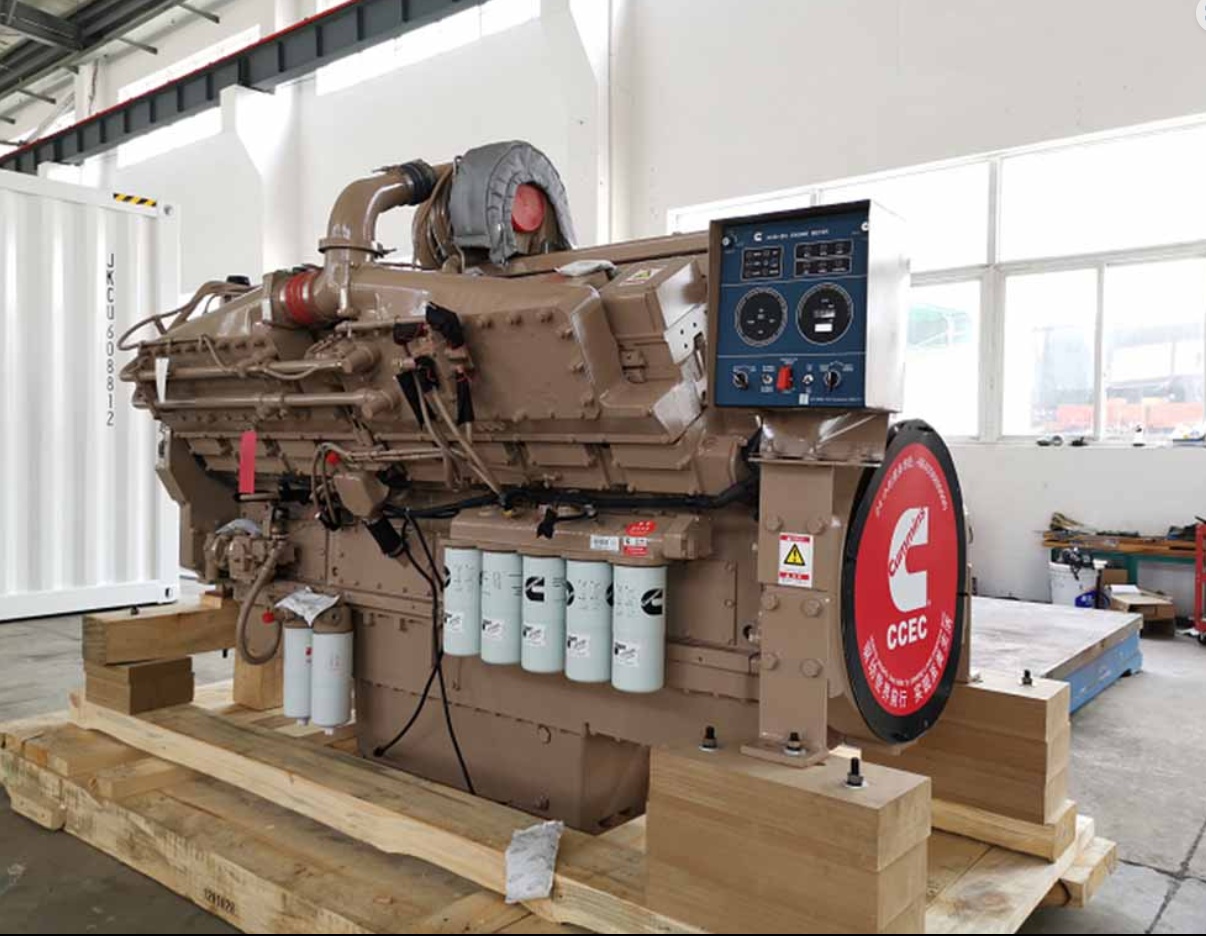
What Is the KTA50 Engine?
The Cummins KTA50 is a 50.3-liter (3,067 cubic-inch), four-stroke diesel engine built in a 60° V16 configuration. Like its smaller siblings — the NT855 (14L inline-six), the KTA19 (19L inline-six), and the KTA38 (38L V12) — the KTA50 uses the same 159 mm × 159 mm bore and stroke that defines the Cummins large-bore family. The difference is simply the number of cylinders: sixteen, arranged in two banks of eight at a 60° angle.
The KTA50 shares the legendary PT (Pressure-Time) fuel system with every other mechanical Cummins engine. There are no electronic control modules, no sensors to fail, no software to update. Fuel delivery is managed entirely through mechanical pressure and timing — a philosophy that makes the KTA50 operational in the most remote corners of the planet, from high-altitude mines in the Andes to off-grid construction sites in Central Africa.
At 50.3 liters of displacement and up to 2,250 HP, the KTA50 represents the ceiling of what mechanical diesel technology can achieve. It is, quite literally, as big as Cummins goes.
The KTA50 Family — Six Variants Explained
The KTA50 lineup includes six distinct variants, each targeting a specific power band and application profile. Here is what sets them apart:
KTA50-C/P/L1600 — The Foundation (1,600 HP)
The KTA50-C/P/L1600 is the entry point to the V16 platform, rated at 1,600 HP (1,193 kW) at 2,100 RPM with peak torque reaching 5,966 N·m. It uses a single-stage turbocharger with aftercooling — the simplest aspiration configuration in the KTA50 family. The 2,100 RPM rated speed makes this variant suitable for applications that need both high power and responsive throttle behavior. For operations upgrading from the KTA38 platform (which tops out at 1,200 HP), the C/P/L1600 delivers a 33% power increase on the same mechanical architecture philosophy.
KTA50-C1600-II — The Refined Standard (1,600 HP)
The KTA50-C1600-II maintains the same 1,600 HP rating but represents an improved iteration of the base C/P/L1600. With peak torque reaching approximately 6,100–6,291 N·m at 1,500 RPM and a slightly optimized wet weight of 5,153 kg, the C1600-II delivers more consistent torque delivery and refined component specifications. This variant is often specified for applications that require reliable 1,600 HP output with enhanced durability margins — such as large mining trucks and continuous-duty industrial equipment.
KTTA50-C1800 — The Twin-Turbo Step (1,800 HP)
The KTTA50-C1800 marks a significant technical leap: it is the first KTA50 variant to use two-stage turbocharging. Rated at 1,800 HP (1,342 kW) at 1,900–2,100 RPM with an extraordinary 8,679–8,849 N·m of peak torque, the C1800 generates massive low-end pulling power. The dual-turbo system compresses intake air in two stages, achieving higher boost pressures than single-stage turbocharging can deliver. The result is significantly more torque at lower RPM — a critical advantage for heavy haul trucks operating on steep gradients.
KTA50-C2000 — The High-Power Workhorse (2,000 HP)
The KTA50-C2000 delivers 2,000 HP (1,492 kW) at 1,900 RPM with 7,865 N·m of peak torque at 1,500 RPM. This variant also uses two-stage turbocharging, but the compression ratio drops slightly to 13.8:1 (compared to 13.9:1 on most other variants) to accommodate the higher boost pressures generated at this power level. The lower rated speed (1,900 RPM) aligns well with industrial generator set applications, where 60 Hz electrical output requires precise speed control. For help sizing a generator set around this engine, see our diesel generator sizing guide.
KTTA50-C2000 — The Torque King (2,000 HP)
The KTTA50-C2000 shares the same 2,000 HP power rating as the C2000 above, but delivers dramatically more torque: 9,200–9,400 N·m compared to 7,865 N·m on the KTA50-C2000. The difference lies in turbocharger calibration and fuel delivery mapping. The KTTA50-C2000 prioritizes maximum torque output for mobile equipment applications — haul trucks, large excavators, and drilling rigs — where the ability to move heavy loads from standstill is more critical than steady-state generator performance.
KTA50-C2250 — The Flagship (2,250 HP)
The KTA50-C2250 is the most powerful engine in the entire Cummins mechanical range, delivering 2,250 HP (1,679 kW) at 1,900 RPM with 8,849 N·m of peak torque at 1,500 RPM. Interestingly, it returns to single-stage turbocharging — the engineering team achieved maximum power through optimized fuel delivery and combustion efficiency rather than adding turbo complexity. At 5,300–5,600 kg, it is also the heaviest variant. The C2250 is specified for the world’s most demanding applications: ultra-class mining trucks, the largest drilling rigs, and high-capacity continuous power installations.
Single-Stage vs Two-Stage Turbocharging
One of the most important technical distinctions in the KTA50 family is the turbocharging configuration:
- Single-stage turbocharging: Used on the C/P/L1600, C1600-II, and C2250. One turbocharger per engine. Simpler to maintain, fewer parts, proven reliability. Best suited for applications where maximum torque at low RPM is less critical than overall power output and maintenance simplicity.
- Two-stage turbocharging: Used on the KTTA50-C1800, KTA50-C2000, and KTTA50-C2000. Two turbochargers operating in sequence — the first stage provides initial compression, and the second stage further increases boost pressure. This delivers significantly more torque at lower RPM, but adds complexity to the intake and exhaust plumbing.
The choice between single-stage and two-stage depends on your application. Mobile equipment that frequently operates under heavy load at low speed benefits enormously from two-stage torque. Stationary installations like generator sets often prefer single-stage for its maintenance simplicity.
KTA50 Technical Specifications
| Specification | C/P/L1600 | C1600-II | KTTA50-C1800 | C2000 | KTTA50-C2000 | C2250 |
|---|---|---|---|---|---|---|
| Rated Power | 1,600 HP @ 2100 RPM | 1,600 HP | 1,800 HP @ 1900–2100 RPM | 2,000 HP @ 1900 RPM | 2,000 HP @ 1900 RPM | 2,250 HP @ 1900 RPM |
| Peak Torque | 5,966 N·m | ~6,100–6,291 N·m | 8,679–8,849 N·m | 7,865 N·m | 9,200–9,400 N·m | 8,849 N·m |
| Displacement | 50.3 L (3,067 in³) — All variants identical | |||||
| Cylinder Configuration | 16 Cylinder, 60° Vee | |||||
| Bore × Stroke | 159 mm × 159 mm (6.25 in × 6.25 in) | |||||
| Compression Ratio | 13.9 : 1 | — | 13.9 : 1 | 13.8 : 1 | 13.9 : 1 | 13.9 : 1 |
| Aspiration | Single-Stage | Single-Stage | Two-Stage | Two-Stage | Two-Stage | Single-Stage |
| Fuel System | PT (Pressure-Time) | |||||
| Emission Standard | Euro II | |||||
| Weight (approx.) | 4,800–5,100 kg | ~5,153 kg (wet) | 4,900–5,300 kg | ~5,298 kg (wet) | — | 5,300–5,600 kg |
| Packing Size | 2,690 mm × 1,560 mm × 2,260 mm | |||||
Key Design Features of the KTA50 Platform
1. V16 Architecture — Unmatched Power Density
Sixteen cylinders in a 60° V configuration provide the smoothest possible power delivery at this displacement level. With sixteen firing events per two crankshaft revolutions, the KTA50 produces continuous, overlapping power pulses that virtually eliminate torsional vibration. This smoothness protects downstream equipment — generator couplings, transmission input shafts, and hydraulic pump drives all last longer when powered by a V16.
2. PT Fuel System — Zero Electronics, Maximum Uptime
The mechanical PT fuel system is the KTA50’s most distinctive feature in an era of electronic engine management. There is no ECU, no wiring harness to degrade, no software to update. A field technician with a pressure gauge and basic hand tools can calibrate the entire fuel system. This makes the KTA50 uniquely suited for operations in regions where dealer support infrastructure is limited or non-existent. For common fuel system issues and diagnostic procedures, refer to our Cummins engine troubleshooting guide.
3. Common Bore & Stroke Across the Entire Cummins Range
The 159 mm × 159 mm bore and stroke is shared across the NT855, KTA19, KTA38, and KTA50 families. This means that fundamental combustion chamber geometry, piston ring specifications, and valve train design principles are consistent throughout the range. Technicians who understand one Cummins large-bore engine can apply that knowledge to all of them. For help identifying which Cummins family an engine belongs to, see our engine identification guide.
4. High-Altitude Capability
Mining operations at altitude — in the Andes, the Tibetan Plateau, or the highlands of East Africa — demand engines that maintain power despite thin air. The KTA50’s turbocharging system (particularly the two-stage variants) compensates for reduced atmospheric pressure by compressing intake air more aggressively. The result is consistent rated power even at elevations where naturally aspirated engines would lose 30–40% of their output.
Applications: Where the KTA50 Operates
The KTA50 is specified for the most extreme industrial applications on Earth:
Ultra-Class Mining Trucks
The world’s largest haul trucks — with payload capacities of 200–400 tons — rely on KTA50 engines (typically the C2000 or C2250) to move hundreds of tons of material up steep haul roads. The massive torque output at low RPM enables these vehicles to start moving under full load without stalling.
Large-Scale Drilling Rigs
Blast hole drills, rotary drilling rigs, and down-the-hole hammer rigs require sustained high torque at low RPM to drive drill bits through hard rock formations. The KTA50’s displacement and turbocharging provide the continuous torque these applications demand.
Prime & Standby Power Generation
A KTA50-powered generator set can deliver 800–1,200 kW of electrical output depending on alternator efficiency and installation conditions. The C2000 and C1100 (from the KTA38 family) are commonly specified for data center backup power, hospital power systems, and industrial prime power installations. For guidance on calculating your power requirements, see our generator engine sizing guide.
Heavy Marine Applications
In large workboats, tugs, and small cargo vessels, the KTA50 serves as main propulsion or auxiliary power. The mechanical fuel system is particularly advantageous in marine environments, where salt-laden air rapidly corrodes electronic components. For marine engine selection guidance, refer to our marine diesel engine selection guide.
Heavy Construction & Infrastructure
The largest bulldozers, compactors, and crane installations use the KTA50 when the power requirements exceed what a KTA38 can deliver. The V16 configuration provides smoother operation than a V12 at equivalent power levels, reducing fatigue on the machine’s structural components.
Parts & Maintenance: What Operators Need to Know
The KTA50’s mechanical simplicity means lower maintenance complexity, but its massive size demands respect:
- PT Fuel System: The dual PT pump configurations on higher-output variants require periodic calibration. Injector replacement follows standard Cummins intervals. Fuel quality is critical — contaminated fuel is the primary cause of PT system failures.
- Turbochargers: Single-stage variants have one turbo; two-stage variants have two. Inspect shaft play, compressor wheel condition, and waste-gate operation at each scheduled maintenance interval. Two-stage systems require attention to the inter-stage plumbing and connections.
- Aftercoolers: Air-to-water aftercoolers must be maintained with properly treated coolant. Cavitation erosion and scale buildup are the primary failure modes — both preventable with regular coolant testing and treatment.
- Cylinder Liners: Wet-type liners are field-replaceable. At major overhaul, all 16 liners can be replaced without removing the engine from the installation in most configurations.
- Oil System: The KTA50 uses a gear-driven oil pump with full-flow and bypass filtration. Oil analysis should be performed at regular intervals to detect early signs of component wear.
Buying Guide: Selecting the Right KTA50 Variant
With six variants spanning 1,600 to 2,250 HP, choosing the correct KTA50 requires matching engine characteristics to your application:
For mining haul trucks: Prioritize torque over peak power. The KTTA50-C1800 or KTTA50-C2000 (two-stage turbo, maximum torque at low RPM) are typically the best choices. If your haul roads are steep and your loads are maximum payload, the extra 1,500+ N·m of torque from the two-stage variants makes a real difference in cycle times.
For generator sets: The KTA50-C2000 (1,900 RPM) or C/P/L1600 (2,100 RPM) are common choices. The single-stage turbo configuration is preferred for its maintenance simplicity in stationary installations where maximum low-speed torque is less critical.
For maximum power applications: The C2250 at 2,250 HP is the undisputed flagship. If your application demands every available horsepower from the mechanical platform, this is the only choice.
For budget-conscious upgrades from KTA38: The C/P/L1600 provides the lowest entry cost into the V16 platform while delivering 33% more power than the largest KTA38. It is an excellent choice for operations that need V16 capability but do not require output above 1,600 HP.
When purchasing — whether new, rebuilt, or used — always verify the engine serial number and CPL (Configuration Parts List) number against the manufacturer’s build sheet. The CPL number tells you exactly how the engine was built from the factory, including turbocharger specifications, fuel pump calibration, and emission configuration.
Frequently Asked Questions
Is the KTA50 the largest Cummins engine?
The KTA50 is the largest mechanically-controlled Cummins engine for industrial applications, with 50.3 liters of displacement and up to 2,250 HP. Cummins does produce larger engines (such as the QSK60 and QSK78) for mining, but those use electronic engine management rather than the mechanical PT fuel system.
What is the difference between KTA50 and KTTA50?
The “TT” in KTTA50 indicates two-stage (twin) turbocharging. KTA50 variants use single-stage turbocharging; KTTA50 variants use two-stage turbocharging. The two-stage configuration delivers significantly more torque at lower RPM.
Can a KTA50 replace a KTA38?
Physically, the KTA50 is larger and heavier than the KTA38. Replacement is possible if the installation has adequate space and weight capacity, and if the application can utilize the additional power (1,600+ HP vs the KTA38’s 900–1,200 HP range). The mounting points and coupling specifications differ between platforms.
What fuel does the KTA50 consume at full load?
At rated power, a KTA50-C2250 typically consumes approximately 400–450 liters of diesel per hour. Actual fuel consumption depends on load factor, altitude, ambient temperature, and engine condition.
Are KTA50 parts still manufactured?
Yes. The KTA50 platform remains in active production and is fully supported by the Cummins global parts network. OEM parts, quality aftermarket alternatives, and rebuilt assemblies are all available through authorized distributors and specialist suppliers like BLSH.
How does the KTA50 compare to electronically controlled engines?
Electronic engines (such as the QSK series) offer tighter emission control and more precise fuel mapping. However, the KTA50’s mechanical PT system offers superior field serviceability, zero electronic dependency, and simpler troubleshooting. For operations in remote locations with limited technical infrastructure, the KTA50’s mechanical advantage is decisive.
Conclusion: The Pinnacle of Mechanical Diesel Power
The Cummins KTA50 represents the absolute limit of what mechanical diesel engineering can achieve. With 50.3 liters of displacement, a V16 configuration, and power output reaching 2,250 HP, it is the largest, most powerful mechanical diesel engine in the Cummins industrial range — and quite possibly one of the largest in the world.
Its strength lies not in complexity, but in simplicity. The PT fuel system, the common bore-and-stroke architecture, the mechanically controlled turbocharging — all of these features make the KTA50 an engine that can be operated, maintained, and repaired anywhere on Earth by technicians with standard tools and proper training.
If your application demands maximum power with maximum reliability and minimum electronic dependency, the KTA50 has no equal. And when you are ready to discuss specifications, availability, or pricing — we are here to help.
Need a KTA50 engine or spare parts? Contact BLSH at [email protected] — we supply complete engines, rebuild kits, and genuine parts for the entire Cummins industrial range, from the smallest inline-six to the flagship V16.
- Prime Power vs Standby vs Continuous: ISO 8528 Generator Rating Definitions Explained
- Diesel Generator Fuel Consumption Chart: Cummins Engine Data from 100 to 1,500 kVA
- KTA19 Generator Engine: Complete Specs, Power Ratings, Weight & Fuel Consumption Guide
- Cummins NTA855 Generator Engine: Complete Specifications, Weight & Fuel Consumption Guide
- NTA855 vs KTA19 vs KTA38 vs KTA50: Complete Cummins Generator Engine Comparison