KTA38 Engine: The Complete Guide to Cummins’ 38L V12 Industrial Powerhouse
When your operation demands more than an inline-six can deliver — but a 50-liter V16 feels excessive — there is one engine that sits squarely in the sweet spot: the Cummins KTA38. With 38 liters of displacement in a 60° V12 configuration and power spanning 900 to 1,200 horsepower, the KTA38 has powered some of the world’s most demanding mining, construction, and industrial applications for decades.
This guide covers every KTA38 variant in detail — from the entry-level C/P/L900 to the top-spec C1200 — along with specifications, real-world applications, maintenance insights, and purchasing advice. Whether you are spec’ing a new engine or evaluating a replacement, this is the definitive resource for the KTA38 platform.
What Is the KTA38 Engine?
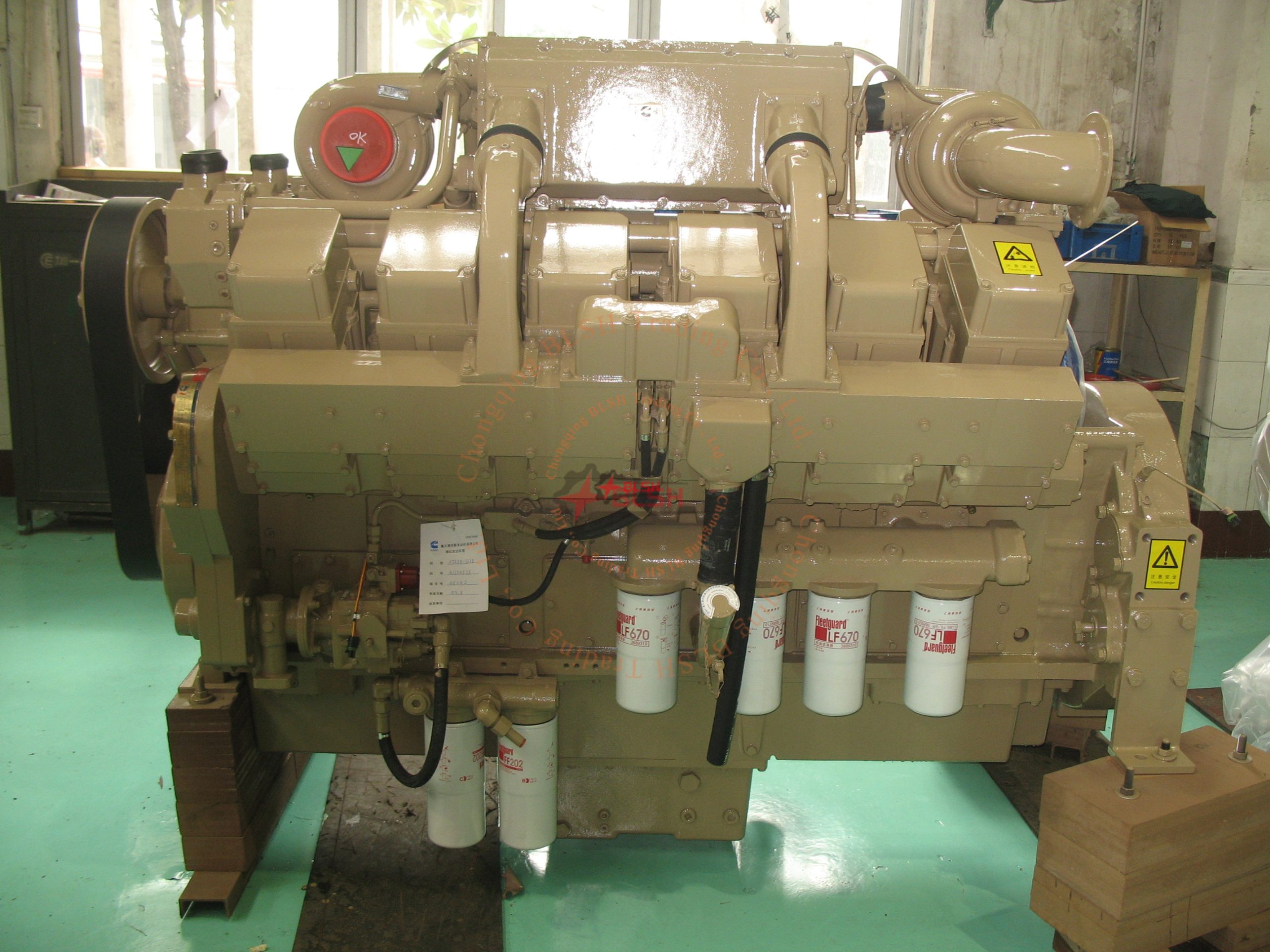
The Cummins KTA38 is a 37.7-liter (2,301 cubic-inch), four-stroke diesel engine built in a 60° V12 configuration. The designation tells the story: K indicates the engine family, T stands for turbocharged, and A means aftercooled. With a bore and stroke of 159 mm × 159 mm across all 12 cylinders, the KTA38 delivers displacement where it counts — in the low-end torque that heavy industrial equipment demands.
At its core, the KTA38 uses Cummins’ legendary PT (Pressure-Time) fuel system — a purely mechanical design that has powered millions of operating hours in the harshest environments on Earth. There are no electronics to fail, no ECU to troubleshoot. A competent field technician with standard tools can diagnose and repair the PT system anywhere in the world.
All KTA38 variants share the same robust block architecture, crankshaft design, and cylinder head configuration. The differences lie in turbocharging specs, fuel delivery calibration, and rated output. Every variant maintains the 13.9:1 compression ratio that balances power density with fuel efficiency.
Where the KTA38 Sits in the Cummins Lineup
Understanding the KTA38 requires understanding its position relative to its siblings. If you are coming from a smaller engine platform, our guides on the NT855 engine (14L inline-six, 250–400 HP) and the KTA19 engine (19L inline-six, 450–700 HP) provide useful context.
The KTA38 occupies the critical middle ground:
- Below KTA38: The KTA19 offers up to 700 HP from 19 liters in an inline-six layout. It is an excellent choice for applications that do not exceed 700 HP.
- KTA38 range: 900 to 1,200 HP from 38 liters in V12 configuration. This is the zone where V12 architecture becomes necessary — the displacement and cylinder count required to deliver smooth, reliable power at these levels.
- Above KTA38: The KTA50 steps up to 50 liters and V16 architecture, delivering 1,600–2,250 HP for the most extreme applications.
The transition from KTA19 (inline-six) to KTA38 (V12) represents a fundamental architecture change — not just a power bump. The V12 layout provides smoother power delivery, better balance at high torque outputs, and the displacement needed for sustained heavy-load operation.
All KTA38 Variants Explained
The KTA38 family consists of five primary variants, each tuned for a specific power band. Here is what differentiates them:
KTA38-C/P/L900 — The Entry Point (900 HP)
The KTA38-C/P/L900 is the gateway to the V12 platform. Rated at 900 HP (671 kW) at 1,800 RPM with 3,916 N·m of peak torque at 1,500 RPM, this variant delivers substantial power while maintaining the most accessible price point in the KTA38 range. It shares the same block, crankshaft, and cylinder head as higher-output variants — the difference is primarily in turbocharger calibration and fuel delivery settings. For operations that need V12 reliability but do not require output above 900 HP, the C/P/L900 is the logical choice.
KTA38-C925 — The Workhorse (925 HP)
The KTA38-C925 steps up to 925 HP (689 kW) at 2,100 RPM with 4,095 N·m of peak torque at 1,300 RPM. Notice the higher rated speed — this variant is tuned for applications that need more sustained power at higher RPM. The torque peak arrives earlier (1,300 RPM vs 1,500 RPM on the C/P/L900), giving it stronger pull from low speeds. This makes the C925 particularly well-suited for haul trucks and heavy earthmoving equipment where immediate torque response matters.
KTA38-C1050 — The High-Output (1,050 HP)
The KTA38-C1050 delivers 1,050 HP (783 kW) at 2,100 RPM with a torque range of 4,068–4,631 N·m between 1,300–1,500 RPM. This is the variant for operations that need to maximize output from the 38-liter platform without moving to the C1100 or C1200. The broad torque band means the engine performs consistently across varying load conditions — a critical advantage in drilling rigs and large excavators where load fluctuates continuously.
KTA38-C1100 — The Industrial Specialist (1,100 HP)
The KTA38-C1100 is rated at 1,100 HP (821 kW) at 1,800 RPM. This variant is optimized for industrial and power generation applications where rated speed is lower but continuous power output is higher. The 1,800 RPM rating aligns perfectly with 50 Hz generator set requirements, making the C1100 a popular choice for large standby and prime power installations. For guidance on sizing an engine for generator applications, see our diesel generator sizing guide.
KTA38-C1200 — The Flagship (1,200 HP)
The KTA38-C1200 is the most powerful variant in the family, delivering 1,200 HP (895 kW) at 1,800–2,100 RPM with peak torque of approximately 4,475–4,747 N·m. This variant features a dual PT pump configuration for maximum fuel delivery. It is the go-to choice when the application demands the absolute highest output from the 38-liter platform — typically large mining trucks, heavy-duty drilling rigs, and high-capacity industrial power plants.
KTA38 Technical Specifications
| Specification | C/P/L900 | C925 | C1050 | C1100 | C1200 |
|---|---|---|---|---|---|
| Rated Power | 900 HP @ 1800 RPM | 925 HP @ 2100 RPM | 1,050 HP @ 2100 RPM | 1,100 HP @ 1800 RPM | 1,200 HP @ 1800–2100 RPM |
| Peak Torque | 3,916 N·m @ 1500 RPM | 4,095 N·m @ 1300 RPM | 4,068–4,631 N·m @ 1300–1500 RPM | — | ~4,475–4,747 N·m |
| Displacement | 37.7 L (2,301 in³) — All variants identical | ||||
| Cylinder Configuration | 12 Cylinder, 60° Vee | ||||
| Bore × Stroke | 159 mm × 159 mm (6.25 in × 6.25 in) | ||||
| Compression Ratio | 13.9 : 1 | ||||
| Aspiration | Turbocharged & Aftercooled | ||||
| Fuel System | PT (Single) | PT (Single) | PT (Single) | PT (Single) | PT (Dual Pump) |
| Emission Standard | Euro II | ||||
| Weight (approx.) | 3,600–3,800 kg | 3,600–4,000 kg | 3,600–4,000 kg | 3,700–4,000 kg | 3,700–4,000 kg |
| Packing Size | 2,300 mm × 1,700 mm × 2,000 mm | ||||
Key Design Features of the KTA38 Platform
1. The PT Fuel System — Mechanical Simplicity at Its Finest
Every KTA38 variant uses the Cummins PT fuel system — a design philosophy unique to Cummins that measures fuel delivery by the pressure applied and the time the fuel flows. Unlike common-rail systems that depend on electronic control units, the PT system is entirely mechanical. This means zero electronic failures, no ECU replacement costs, and the ability to perform field repairs with basic hand tools.
In remote mining operations across Central Asia, Africa, and South America, this mechanical simplicity is not a convenience — it is a necessity. If you need help diagnosing fuel system issues, our Cummins engine troubleshooting guide covers common PT system problems and solutions.
2. V12 Architecture — Smooth Power, Balanced Loads
The 60° V12 configuration provides inherent balance that inline engines cannot match at this power level. Twelve firing intervals per two crankshaft revolutions deliver continuous, overlapping power pulses — resulting in significantly less vibration than an inline-six at equivalent output. This smoothness translates directly into longer component life for driven equipment: transmissions, couplings, and generator ends all benefit from reduced torsional vibration.
3. Common Architecture Across All Variants
Every KTA38 — from the 900 HP entry model to the 1,200 HP flagship — shares the same cylinder block, crankshaft, connecting rods, and cylinder head castings. This parts commonality is a massive operational advantage. Operators running mixed fleets can stock a single set of major overhaul kits, reducing inventory costs and ensuring that any KTA38 in the fleet can be serviced with the same core components.
4. Turbocharged & Aftercooled Aspiration
All variants use exhaust-driven turbocharging with air-to-water aftercooling. The aftercooler reduces intake air temperature after compression, increasing air density for more efficient combustion. The result is better fuel economy, lower exhaust temperatures, and improved emissions — all critical factors in enclosed or underground installations.
Applications: Where the KTA38 Shines
The KTA38 serves a remarkably diverse range of heavy industrial applications:
Mining & Earthmoving
Large haul trucks (100-ton class and above), wheel loaders, and hydraulic excavators rely on the KTA38’s low-end torque to move massive loads from a standstill. The C925 and C1050 are particularly popular in mining, where the broad torque band handles varying gradient conditions without frequent gear changes.
Drilling Rigs
Rotary drilling rigs for mining, water wells, and construction foundations demand high torque at low RPM. The KTA38’s 13.9:1 compression ratio and massive displacement deliver the sustained torque needed for continuous drilling through hard rock formations.
Industrial Power Generation
The C1100 (rated at 1,800 RPM) and C1200 are widely used in prime power and standby generator sets. When properly sized, a KTA38-powered generator can deliver 500–800 kW of electrical output depending on alternator efficiency. For help calculating your power requirements, see our generator engine sizing guide.
Marine — Large Vessel Propulsion
In commercial shipping and large workboat applications, the KTA38 serves as a main propulsion engine or auxiliary power unit. Its mechanical fuel system is advantageous in marine environments where electronic components are vulnerable to salt spray and humidity. For marine engine selection guidance, refer to our marine diesel engine selection guide.
Construction — Heavy Infrastructure
Large bulldozers, compactors, and heavy cranes use the KTA38 for its combination of high torque and proven durability. The common architecture means construction companies running mixed equipment fleets benefit from simplified maintenance and parts logistics.
Parts & Maintenance: What You Need to Know
The KTA38’s mechanical simplicity translates directly into lower maintenance complexity compared to electronically controlled engines. Here are the key maintenance considerations:
- PT Fuel System: Periodic calibration checks and injector replacement at scheduled intervals. The PT pump itself is extremely durable — most failures result from contaminated fuel rather than component wear.
- Turbocharger: Inspect for shaft play and compressor wheel damage at each overhaul. Aftercooler cores should be cleaned chemically to remove scale and deposits.
- Cylinder Liners: The KTA38 uses wet-type cylinder liners that are replaceable without removing the engine from the installation. This significantly reduces overhaul downtime.
- Valve Train: Overhead valve adjustment is a routine maintenance task. The V12 configuration requires accessing both cylinder banks, but the valve clearance specifications are straightforward.
- Cooling System: The aftercooler circuit requires clean, treated coolant. Neglecting coolant treatment is the single most common cause of aftercooler leaks and cylinder liner cavitation erosion.
For detailed troubleshooting procedures, our Cummins engine troubleshooting guide covers the KTA38 platform extensively. If you need to verify engine identity before ordering parts, the Cummins engine identification guide explains how to read the data plate and decode the model number.
Buying Guide: Choosing the Right KTA38 Variant
Selecting the correct KTA38 variant depends on three factors: required power output, rated speed, and application type.
If your current engine is in the 400–700 HP range (such as a KTA19 or large NT855), upgrading to the KTA38 represents a significant capability increase. Start with the C/P/L900 if your application does not demand more than 900 HP — you get the full V12 architecture at the most accessible price point.
If you need 900–1,050 HP for mobile equipment (haul trucks, excavators, drilling rigs), the C925 or C1050 offer the best combination of power and torque response. The 2,100 RPM rated speed provides the flexibility needed for transmission-driven applications.
If you are spec’ing a generator set, look at the C1100 or C1200. Their 1,800 RPM rating matches 50 Hz electrical output requirements directly, and the higher continuous power rating accounts for generator set derating factors.
When purchasing — whether new, rebuilt, or used — always verify the engine’s complete data plate information against the manufacturer’s build sheet. Our used engine buying guide outlines the inspection process (the principles apply equally to KTA38 evaluations, despite covering a different series).
Frequently Asked Questions
Is the KTA38 a V12 engine?
Yes. The KTA38 is a 60° V12 diesel engine with 37.7 liters of total displacement. All 12 cylinders share the same bore and stroke (159 mm × 159 mm).
What is the difference between KTA38 and KTA19?
The KTA19 is a 19-liter inline-six engine producing 450–700 HP. The KTA38 is a 38-liter V12 producing 900–1,200 HP. They share the PT fuel system philosophy but differ fundamentally in architecture, displacement, and power class. The KTA38 is the natural upgrade path from the KTA19 when higher output is required.
Can a KTA38 replace a KTA50?
Only if the application can operate within the 900–1,200 HP range. The KTA50 starts at 1,600 HP. If your application requires less than 1,200 HP, the KTA38 is the more fuel-efficient and cost-effective choice.
What fuel does the KTA38 use?
The KTA38 runs on diesel fuel (No. 2 diesel or equivalent). The PT fuel system is tolerant of varying fuel qualities, which is one reason it remains popular in regions with inconsistent fuel supply chains.
How often does the KTA38 need a major overhaul?
With proper maintenance — including regular oil changes, coolant treatment, and air filtration — the KTA38 typically achieves 15,000–20,000 hours before major overhaul. Actual overhaul intervals depend heavily on application severity, load factors, and maintenance quality.
Are KTA38 parts still available?
Yes. The KTA38 platform is one of the most widely supported engines in the Cummins global network. OEM parts, aftermarket alternatives, and rebuilt components are all readily available through authorized distributors and specialist suppliers like BLSH.
Conclusion: Why the KTA38 Remains Relevant
In an era of increasing electronic engine management, the KTA38 stands as proof that mechanical engineering excellence never becomes obsolete. Its V12 architecture delivers smooth, reliable power in the critical 900–1,200 HP range. Its PT fuel system ensures operability in the world’s most remote locations. And its common architecture across all five variants simplifies fleet maintenance like few other engine platforms can.
Whether you are spec’ing new equipment, repowering an aging fleet, or sourcing replacement engines for existing installations, the KTA38 deserves serious consideration. And when you are ready to talk specifications, availability, or pricing — our team is here to help.
Have a question about the KTA38 or need a quote? Contact BLSH at [email protected] — we supply complete engines, spare parts, and technical support for the entire Cummins industrial range.
- KTA38 Engine: The Complete Guide to Cummins’ 38L V12 Industrial Powerhouse
- KTA19 Engine: The Complete Guide to Cummins’ 19L Heavy-Duty Powerhouse
- NT855 Engine: The Complete Guide to Cummins’ Legendary Industrial Platform
- Truck Diesel Engine Selection: The Complete Guide for Fleet Operators
- Excavator Engine Replacement: The Complete Guide for 2026