
M11 Engine: The Complete Guide to Cummins’ 10.8L Inline-6 Industrial Workhorse
If you operate industrial diesel equipment in the 185–380 HP range, chances are you’ve already encountered the Cummins M11 — or will soon. It is one of the most widely deployed medium-duty industrial engine platforms in the world, powering everything from truck-mounted cranes and drilling rigs to generator sets and marine auxiliary equipment.
Unlike the legendary NT855 series with its 14L displacement, or the high-output KTA19 pushing 700 HP, the M11 occupies a uniquely versatile middle ground: a 10.8L inline-6 that is lighter, more compact, and more fuel-efficient than its bigger siblings — while still delivering serious torque for heavy-duty work.
This guide covers every M11 variant available from Chongqing Cummins (CCEC), their specifications, torque data, application fit, and how to choose the right one for your equipment. Whether you are spec’ing a new power unit or sourcing replacement parts, this is the reference you need.
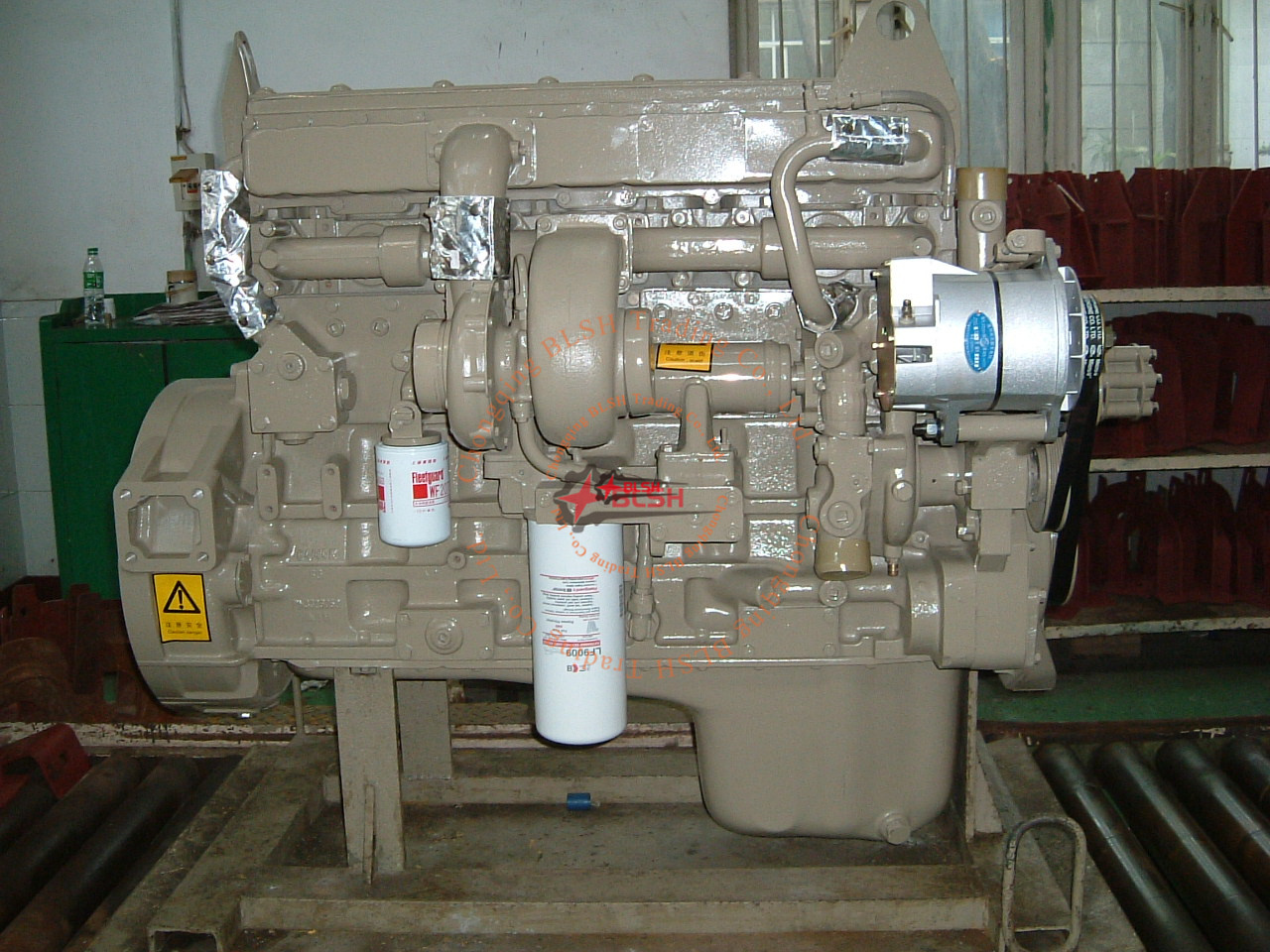
M11 Family Overview: Core Architecture
Before diving into individual variants, here is what every M11 engine shares. Understanding the common architecture helps you see why this platform is so adaptable — and why parts interchangeability across the range is so strong.
| Parameter | Value |
|---|---|
| Configuration | 4-Stroke, In-line 6 Cylinder |
| Displacement | 10.8 L (659 cu.in) |
| Bore × Stroke | 125 mm × 147 mm |
| Compression Ratio | 16.1 : 1 |
| Fuel System | PT-STC (Direct Injection) |
| Aspiration | Turbocharged & Water-Air Intercooled |
| Dry Weight | ~940 kg |
| Overall Dimensions (L×W×H) | 3,200 mm × 980 mm × 1,760 mm |
| Firing Order | 1-5-3-6-2-4 |
| Emission Standard | Euro II / Tier 1 (varies by variant) |
That 16.1:1 compression ratio is notably high for a diesel of this era — it reflects Cummins’ optimization for thermal efficiency. Combined with the PT-STC fuel system (more on that below), the M11 extracts more energy per liter of fuel than many competitors in its class. For reference, the 6BT series runs a similar ratio, but in a much smaller 5.9L package; the M11 scales that efficiency up to industrial-grade output.
If you need help identifying whether your equipment uses an M11 or another Cummins platform, our engine identification guide walks you through nameplate reading, physical differences, and specification cross-referencing.
The Complete M11 Variant Lineup
The M11 family is remarkably broad. From the 185 HP C225A all the way to the 380 HP C380E20, there are over 18 distinct variants — each tuned for different power requirements and application profiles. The table below organizes them by output level.
| Model | Rated Power | Max Torque | Rated Speed | Emission |
|---|---|---|---|---|
| M11-C225A | 185 HP (138 kW) | — | 1850 RPM | Euro II |
| M11-C225D | 225 HP (168 kW) | 1,031 Nm @ 1300 RPM | 2100 RPM | Euro II |
| M11-C225E | 275 HP (205 kW) | 1,288 Nm @ 1300 RPM | 1800/2100 RPM | Euro II |
| M11-C250A | 250 HP (186 kW) | 1,019 Nm @ 1300 RPM | 2100 RPM | Euro II |
| M11-C250B | 250 HP (186 kW) | 1,146 Nm @ 1300 RPM | 2100 RPM | Euro II |
| M11-C250E20 | 250 HP (186 kW) | 1,146 Nm @ 1300 RPM | 2100 RPM | Euro II |
| M11-C270 | 270 HP (201 kW) | 1,248–1,288 Nm @ 1300 RPM | 2100 RPM | Euro II |
| M11-C270E20 | 270 HP (201 kW) | 1,248 Nm @ 1300 RPM | 2100 RPM | National II |
| M11-C290 | 290 HP (216 kW) | 1,329 Nm @ 1300 RPM | 2100 RPM | Euro II |
| M11-C290E20 | 290 HP (216 kW) | — | 2100 RPM | Euro II |
| M11-C300B | 300 HP (216 kW) | 1,329 Nm @ 1300 RPM | 2100 RPM | Euro II |
| M11-C310A | 310 HP (231 kW) | 1,265 Nm @ 1300 RPM | 2100 RPM | Tier 1 |
| M11-C310B | 310 HP (228 kW) | 1,400 Nm @ 1300 RPM | 2100 RPM | Euro II |
| M11-C310E20 | 310 HP (231 kW) | — | 2100 RPM | Euro II |
| M11-C330 | 330 HP (246 kW) | 1,458 Nm @ 1300 RPM | 2100 RPM | Tier 1 |
| M11-C330E20 | 330 HP (246 kW) | — | 2100 RPM | Euro II |
| M11-C350 | 350 HP (261 kW) | ~1,560 Nm @ 1300 RPM | 2100 RPM | Tier 1 / Euro II |
| M11-C380E20 | 380 HP (283 kW) | 1,650 Nm @ 1300 RPM | 2100 RPM | National II |
A few things worth noting:
- Power range is enormous — 185 to 380 HP from a single 10.8L architecture. That’s a 2:1 ratio between the weakest and strongest variant.
- Peak torque consistently lands at 1,300 RPM across the entire family. This is a hallmark of the M11’s tuning philosophy: low-end grunt for industrial applications where the engine rarely runs at rated speed.
- The “E20” suffix designates engines meeting China National II emission standards, while non-E20 variants typically meet Euro II or Tier 1. This matters if you are exporting equipment or operating in regions with specific emission requirements.
- Model naming can be confusing — the M11-C225E, for example, actually produces 275 HP despite “225” in its name. Always verify by rated power figures, not model number alone.
Power Band Breakdown: Choosing the Right Segment
With 18 variants to choose from, the key question is: which power band fits your application?
Light Duty Segment: 185–250 HP
The lower end of the M11 range — variants like the C225A (185 HP), C225D (225 HP), C250A/B (250 HP) — serves applications where fuel economy matters more than raw output. Think light-duty pump sets, small compressor units, auxiliary power for marine vessels, or equipment that runs at partial load most of the time.
At 940 kg dry weight, the M11 is already significantly lighter than the NT855-C280 at comparable power levels. If your current equipment uses an NT855 in this power range, downsizing to an M11 can reduce overall weight by 100+ kg — meaningful for mobile applications like truck-mounted cranes.
Mid-Range Segment: 270–310 HP
This is the M11’s sweet spot and where you’ll find the highest volume of deployments. The M11-C290 (290 HP, 1,329 Nm) and M11-C330 (330 HP, 1,458 Nm) are the two best-selling variants globally, and for good reason.
The 270–310 HP range covers the majority of:
- Heavy-duty truck and tractor applications
- Medium generator sets (80–200 kW)
- Construction equipment (excavators, loaders, dozers)
- Industrial pump and compressor drives
For context, the NT855-C310 produces similar power (310 HP) but from 14L displacement — consuming more fuel and adding more weight to do it. The M11 achieves the same output from 25% less displacement, which is the fundamental reason this platform has replaced the NT855 in most mid-range applications.
High-Output Segment: 330–380 HP
At the top of the range, the M11-C350 (350 HP, ~1,560 Nm) and M11-C380E20 (380 HP, 1,650 Nm) push the 10.8L platform to its engineering limits. These variants are chosen when you need maximum power from a compact inline-6 package — typical applications include heavy-haul trucks, high-capacity generator sets, and demanding construction machinery.
The C380E20, with 1,650 Nm of torque, actually exceeds the output of some NT855 variants at higher power settings. That torque density — 153 Nm per liter of displacement — is exceptional for a mechanically governed diesel.
For applications requiring more than 380 HP, you’ll need to step up to the KTA19 series (450–700 HP from 19L) or the KTA38 V12 (900+ HP). But for most industrial, trucking, and power generation needs, the top-tier M11 variants hit the mark without the cost and complexity of a larger engine.
The PT-STC Fuel System: M11’s Core Technology
One feature that distinguishes the M11 from both smaller Cummins engines and many competitors is the PT-STC (Pressure-Time, Surface Temperature Control) fuel system. This is an evolution of the classic Cummins PT system — and understanding it is key to both operating and maintaining these engines.
In a standard PT fuel system, fuel pressure is generated by a gear-driven pump and metered by a throttle valve. The “STC” addition means the system also controls the temperature of the fuel at the injection point, which directly affects injection timing accuracy and combustion consistency.
Practical benefits of PT-STC on the M11:
- More consistent combustion across varying ambient temperatures — critical for equipment operating in deserts or cold climates
- Better fuel atomization at the 16.1:1 compression ratio, contributing to the M11’s strong thermal efficiency
- Simplified mechanical timing — no electronic control module to fail, which matters in remote or off-grid applications
- Field-serviceable — PT pump calibration and STC adjustment can be performed with basic tools, unlike common-rail systems that require diagnostic computers
This is why the M11 remains popular in developing markets and remote industrial sites: the PT-STC system is robust, forgiving of varying fuel quality, and can be maintained without specialized electronic equipment. If you’re troubleshooting fuel system issues, our Cummins engine troubleshooting guide covers PT system diagnostics in detail.
Application Guide: Which M11 for Which Job?
Here is a practical selection guide based on common industrial applications:
| Application | Recommended Models | Why |
|---|---|---|
| Truck / Tractor (Highway) | C290, C330, C350 | Peak torque at 1,300 RPM suits constant-speed cruising; good fuel economy in 270–350 HP range |
| Generator Set (Prime Power) | C250B, C270, C290, C310B | Stable 50/60 Hz power generation at 1500/1800 RPM; well-matched to Stamford-style alternators |
| Construction Equipment | C290, C330, C350, C380E20 | High torque rise handles shock loads from digging, lifting, and dozing |
| Marine Auxiliary | C225D, C250A, C270 | Compact footprint fits engine rooms; reliable auxiliary power for onboard systems |
| Pump & Compressor Drive | C225A, C225D, C250B, C270 | Constant-speed industrial duty; good part-load efficiency |
| Crane (Truck-Mounted) | C290, C310B, C330 | Power-to-weight ratio matters; M11 at 940 kg is lighter than NT855 at equivalent output |
For marine main propulsion applications, the M11 is less common — that territory belongs to purpose-built marine engines. See our marine diesel engine selection guide for propulsion-grade options. But for marine auxiliary power (hotel load, hydraulic pumps, anchor winches), the M11 is a proven choice.
For generator applications specifically, proper sizing is critical. Our generator engine sizing guide walks through the calculation from load profile to engine selection — the M11 variants from C250 to C330 cover the majority of prime power needs between 80 and 250 kW.
M11 vs. NT855 vs. KTA19: How They Compare
If you are cross-referencing between Cummins platforms, here is how the M11 stacks up against its closest relatives:
| Parameter | M11 | NT855 | KTA19 |
|---|---|---|---|
| Configuration | Inline 6 | Inline 6 | Inline 6 |
| Displacement | 10.8 L | 14.0 L | 18.9 L |
| Power Range | 185–380 HP | 250–400 HP | 450–700 HP |
| Fuel System | PT-STC | PT | PT |
| Compression Ratio | 16.1:1 | 13.9–16.0:1 | 13.9:1 |
| Dry Weight | ~940 kg | ~1,250 kg | ~1,700 kg |
| Bore × Stroke | 125×147 mm | 140×152 mm | 159×159 mm |
| Best For | Mid-range industrial, trucks, gensets | Heavy industrial, legacy equipment | High-power industrial, mining |
The key takeaway: the M11 replaces the NT855 in the 250–380 HP overlap zone with better fuel efficiency and lighter weight. Where the NT855 still wins is in sheer parts availability (decades of global deployment) and in applications where the heavier engine’s rotational mass provides smoothing benefits. The KTA19 lives in a completely different power class above 450 HP — there is no direct overlap with the M11.
For commercial vehicle applications where you might be choosing between these platforms, our truck engine selection guide provides additional comparison and decision frameworks.
Parts, Maintenance & Longevity
The M11’s parts ecosystem is one of its strongest selling points. Because CCEC has produced this platform for over two decades, supply chains for consumables and wear parts are well-established globally.
Key maintenance intervals:
- Oil & filter: Every 250 hours or 6 months (whichever comes first) for industrial duty; every 15,000 km for on-highway truck use
- Fuel filter (primary + secondary): Every 500 hours; more frequently in dusty environments or with poor fuel quality
- Coolant system flush: Every 2,000 hours or 2 years
- Valve lash adjustment: Every 1,500 hours (intake: 0.36 mm, exhaust: 0.69 mm — verify with your specific variant’s datasheet)
- PT pump calibration check: Every 3,000 hours or if fuel consumption increases noticeably
- Injector inspection/replacement: Every 5,000–8,000 hours depending on fuel quality and operating conditions
Common wear items to stock:
- PT fuel pump rebuild kits
- Injector cups and O-rings
- Turbocharger rebuild kits (water-air intercooler models)
- Cylinder liner kits (available in standard and oversize)
- Main & connecting rod bearing sets
- Complete gasket and seal kits for major overhauls
The complete Chongqing Cummins engine guide covers parts sourcing strategies and which components are shared across the M11, NT855, and KTA families.
With proper maintenance, M11 engines routinely achieve 15,000–20,000 hours before major overhaul in industrial applications, and 800,000–1,000,000 km in on-highway truck service. The 16.1:1 compression ratio puts more stress on internal components than lower-ratio designs, so adhering to oil change intervals is non-negotiable for longevity.
Frequently Asked Questions
What is the difference between M11-C290 and M11-C290E20?
The core engine is identical. The “E20” designation indicates compliance with China National II emission standards. If you are operating outside China or in regions without specific emission requirements, the non-E20 variant is functionally equivalent and often more readily available.
Can I use an M11 to replace my NT855?
In many applications, yes — particularly in the 250–380 HP range where the two platforms overlap. However, you will need to account for differences in mounting points, cooling system connections, and the water-air intercooler plumbing. The M11 is lighter and more compact, so physical installation is rarely the issue; the challenge is usually matching the auxiliary drive configuration and control interfaces.
Is the M11 suitable for generator sets?
Absolutely. The M11-C250 through M11-C330 variants are widely used in diesel generator sets from 80 kW to 250 kW. The constant-speed capability (1500 RPM for 50 Hz, 1800 RPM for 60 Hz) and stable governor response make them well-suited for both prime and standby power generation.
What fuel does the M11 require?
The PT-STC system is relatively forgiving of fuel quality compared to modern common-rail engines. Standard diesel fuel meeting EN 590 or equivalent specifications is required. In markets with high-sulfur diesel, shorten the oil change interval and consider additional fuel filtration. The PT system’s mechanical simplicity is a major advantage in regions where fuel quality is inconsistent.
Where can I source M11 parts?
As a Chongqing Cummins (CCEC) product, M11 parts are available through the global Cummins distributor network as well as specialized industrial engine parts suppliers. For OEM-quality replacement parts at competitive pricing, contact BLSH Diesel — we stock the complete M11 parts catalog and ship worldwide.
Final Thoughts: Why the M11 Remains Relevant
In an era of electronically controlled common-rail engines, the M11’s mechanical PT-STC system might seem old-fashioned. But that’s precisely what makes it valuable: simplicity, durability, fuel flexibility, and field-serviceability without diagnostic laptops.
For industrial operators in developing markets, remote mining sites, marine applications, and heavy trucking — where fuel quality varies, service infrastructure is limited, and downtime costs are brutal — the M11 remains an outstanding choice. It’s the engine that just keeps working.
If you need help selecting the right M11 variant for your application, sourcing parts, or comparing it against other Cummins platforms, reach out to BLSH Diesel. We specialize in Chongqing Cummins engines and maintain inventory across the complete M11, NT855, KTA19, KTA38, and KTA50 range.
- Prime Power vs Standby vs Continuous: ISO 8528 Generator Rating Definitions Explained
- Diesel Generator Fuel Consumption Chart: Cummins Engine Data from 100 to 1,500 kVA
- KTA19 Generator Engine: Complete Specs, Power Ratings, Weight & Fuel Consumption Guide
- Cummins NTA855 Generator Engine: Complete Specifications, Weight & Fuel Consumption Guide
- NTA855 vs KTA19 vs KTA38 vs KTA50: Complete Cummins Generator Engine Comparison