
DCEC Cummins ISLe8.9 Automotive Engine — 8.9L Truck & Bus Power, 270–400 HP
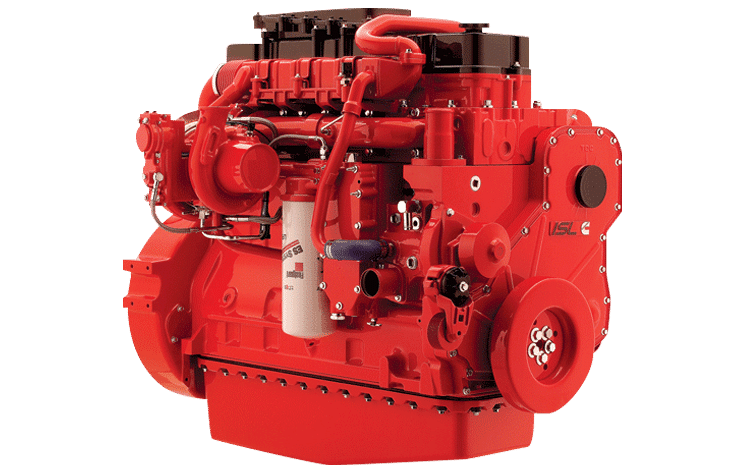
The DCEC Cummins ISLe8.9 is an 8.9-liter, inline 6-cylinder, four-stroke electronically controlled diesel engine designed for medium and heavy-duty commercial vehicles — including long-haul tractors, dump trucks (tippers), intercity coaches, and city buses. Built by Dongfeng Cummins Engine Company (DCEC), the ISLe8.9 features the Cummins CCR high-pressure common rail fuel system (up to 1,800 bar), a Holset wastegated turbocharger with air-to-air intercooling, and a Continental dual-core ECM with OBD and UDS diagnostics. With a power range of 270–400 HP, peak torque up to 1,700 N·m, and a dry weight of only ~707 kg, it delivers one of the best power-to-weight ratios in the 8–9 liter class.
ISLe8.9 General Specifications
| Parameter | Specification |
|---|---|
| Engine Type | Inline 6-cylinder, 4-stroke, water-cooled, electronically controlled |
| Displacement | 8.9 L (8,866 cc) |
| Bore × Stroke | 114 mm × 145 mm |
| Valve Train | 4 valves per cylinder, 24 valves total |
| Aspiration | Turbocharged & air-to-air intercooled (Holset wastegated turbo) |
| Fuel System | Cummins CCR high-pressure common rail (up to 1,800 bar) |
| Control Module | Continental dual-core ECM with OBD & UDS/ODX diagnostics |
| Rated Power | 270–400 HP (199–294 kW) @ 2,100 RPM |
| Peak Torque | 1,050–1,700 N·m @ 1,100–1,700 RPM |
| Rated Speed | 2,100 RPM |
| Emission Standards | Euro III (30), Euro IV (40), Euro V / China V (50) |
| Aftertreatment | Euro IV/V: SCR with DEF/AdBlue; Euro III: in-cylinder calibration only |
| Dry Weight | ~707–714 kg |
| Dimensions (L×W×H) | 1,129 × 876 × 1,076 mm |
| Firing Order | 1–5–3–6–2–4 |
| Best BSFC | ~195 g/kW·h |
| Overhaul Interval (B10) | ~600,000 km (highway operation) |
| Cold Start Capability | –35 °C with intake air preheater |
Why Choose the ISLe8.9 for Trucks & Buses?
1. Best-in-Class Power-to-Weight Ratio
At just ~707 kg dry, the ISLe8.9 is significantly lighter than most 8.9–10 liter competitors. DCEC’s official data puts it at only 714 kg — among the lightest in its displacement class. This translates to higher payload capacity for trucks and better front-axle load distribution for buses, without sacrificing the structural strength expected from a Cummins heavy-duty platform.
2. CCR High-Pressure Common Rail (1,800 bar)
The Cummins CCR common rail system delivers fuel at up to 1,800 bar with multiple injection events per cycle, enabling precise combustion control. The result is strong low-end torque, rapid throttle response, reduced noise, improved cold-start performance, and lower fuel consumption. The Continental dual-core ECM processes load demand, fuel efficiency, and emissions control in real time, maintaining optimal calibration across all operating conditions.
3. Wide Torque Plateau for Fewer Shifts
Across the model range, the ISLe8.9 delivers a broad torque band — typically spanning 1,100 to 1,700 RPM on Euro V models. This means the engine stays in its sweet spot longer, reducing gear shifts, improving gradeability, and lowering driver fatigue on long-haul routes or mountain terrain. The ISLe400-40, for example, produces 1,700 N·m of torque — comparable to many 10–11 liter engines.
4. Proven Durability with Minimal Maintenance
The ISLe8.9 incorporates design features normally found on larger Cummins heavy-duty engines: a reinforced cylinder block with integrated fluid lines, high-strength forged steel crankshaft, high-durability pistons, and mid-stop cylinder liners with special surface finish. The automatic tensioning fan drive belt requires only visual inspection, and fuel injectors need no scheduled inspection. With proper maintenance, B10 overhaul life reaches approximately 600,000 km.
5. Cold-Start & High-Altitude Performance
Equipped with an intake air electric preheater and a high-capacity starter, the ISLe8.9 starts reliably at –35 °C — validated at Mohe, China’s arctic village. It also maintains stable power output at high altitudes, making it suitable for operators in mountainous regions, the Andes, East Africa, and Central Asia.
ISLe8.9 Model Catalog — Euro III (30 Series)
The “30” suffix denotes Euro III / China III emission calibration. These models meet emissions through in-cylinder combustion optimization without SCR aftertreatment, simplifying maintenance for markets where DEF/AdBlue infrastructure is limited. The ISLe325-31 is a city-bus-specific variant rated at 2,200 RPM.
| Engine Model | Rated Power | Peak Torque | Torque RPM | Typical Application |
|---|---|---|---|---|
| ISLe270-30 | 270 HP (199 kW) @ 2100 | 1,050 N·m | 1,000–1,700 | Intercity bus, medium truck |
| ISLe290-30 | 290 HP (213 kW) @ 2100 | 1,050 N·m | 1,000–1,900 | Intercity bus, medium truck |
| ISLe310-30 | 310 HP (228 kW) @ 2100 | 1,200 N·m | 1,000–1,700 | Coach, 6×2 truck |
| ISLe325-31 | 325 HP (239 kW) @ 2200 | 1,350 N·m | 1,100–1,600 | City transit bus |
| ISLe340-30 | 340 HP (250 kW) @ 2100 | 1,425 N·m | 1,100–1,400 | 6×4 tractor, tipper |
| ISLe375-30 | 375 HP (275 kW) @ 2100 | 1,550 N·m | 1,100–1,400 | Heavy tractor, tipper |
ISLe8.9 Model Catalog — Euro IV (40 Series)
The “40” suffix denotes Euro IV / China IV calibration with SCR aftertreatment. Euro IV models use a CES-standard fuel/DEF module. The ISLe400-40 is the top-output variant at 400 HP and 1,700 N·m.
| Engine Model | Rated Power | Peak Torque | Torque RPM | Typical Application |
|---|---|---|---|---|
| ISLe270-40 | 270 HP (199 kW) @ 2100 | 1,050 N·m | 1,400 | Medium truck, bus |
| ISLe290-40 | 290 HP (213 kW) @ 2100 | 1,050 N·m | 1,400 | Intercity coach, 6×2 truck |
| ISLe292-40 | 292 HP (215 kW) @ 2100 | 1,200 N·m | 1,400 | Coach, cargo truck |
| ISLe315-40 | 315 HP (231.5 kW) @ 2100 | 1,200 N·m | 1,400 | 12m coach, 6×2 tractor |
| ISLe325-40 | 325 HP (239 kW) @ 2100 | 1,350 N·m | 1,400 | Coach, 8×4 cargo |
| ISLe340-40 | 340 HP (250 kW) @ 2100 | 1,425 N·m | 1,400 | 6×4 tractor, tipper |
| ISLe360-40 | 360 HP (265 kW) @ 2100 | 1,550 N·m | 1,400 | Heavy tipper, 6×4 tractor |
| ISLe375-40 | 375 HP (275 kW) @ 2100 | 1,550 N·m | 1,400 | Heavy tractor, coach |
| ISLe400-40 | 400 HP (294 kW) @ 2100 | 1,700 N·m | 1,400 | Top-power 6×4 long-haul tractor |
ISLe8.9 Model Catalog — Euro V / China V (50 Series)
The “50” suffix denotes Euro V / China V calibration with upgraded SCR aftertreatment and revised ECU programming. These models feature wider torque plateaus (1,100–1,700 RPM on lower-output variants) for improved driveability and fuel economy. The naming convention drops the “e” (ISL vs. ISLe) on some 50-series units, but the engine platform is identical.
| Engine Model | Rated Power | Peak Torque | Torque RPM | Typical Application |
|---|---|---|---|---|
| ISL290-50 | 290 HP (213 kW) @ 2100 | 1,055 N·m | 1,100–1,700 | Intercity bus, medium truck |
| ISL292-50 | 292 HP (215 kW) @ 2100 | 1,055 N·m | 1,100–1,700 | Coach, cargo truck |
| ISL315-50 | 315 HP (232 kW) @ 2100 | 1,200 N·m | 1,100–1,700 | 12m coach, 6×2 truck |
| ISL325-50 | 325 HP (239 kW) @ 2100 | 1,350 N·m | 1,100–1,500 | Coach, 8×4 cargo |
| ISL340-50 | 340 HP (250 kW) @ 2100 | 1,500 N·m | 1,200–1,400 | 6×4 tractor, tipper |
| ISL360-50 | 360 HP (265 kW) @ 2100 | 1,550 N·m | 1,100–1,400 | Heavy tipper, tractor |
| ISL375-50 | 375 HP (275 kW) @ 2100 | 1,550 N·m | 1,100–1,500 | Heavy long-haul tractor |
| ISLe380-50 | 380 HP (279 kW) @ 2100 | 1,700 N·m | 1,300–1,400 | Premium 6×4 tractor, coach |
Applications: What Vehicles Use the ISLe8.9?
The ISLe8.9 is an on-highway engine purpose-built for commercial road vehicles. It is not an industrial or construction engine — its calibration, mounting points, and cooling package are designed for trucks and buses.
| Vehicle Type | Typical GVW / Class | Recommended HP Range |
|---|---|---|
| Medium-duty cargo trucks (4×2) | 12–18 ton GVW | 270–290 HP |
| Heavy cargo trucks (6×2 / 8×4) | 18–31 ton GVW | 290–340 HP |
| 6×4 long-haul tractors | 40–49 ton GCW | 340–400 HP |
| Dump trucks / tippers (6×4 / 8×4) | 25–40 ton GVW | 340–375 HP |
| Intercity & tourist coaches (10–12m) | 45–55 seats | 290–340 HP |
| City transit buses (11–12m) | Low-floor / BRT | 270–325 HP |
| Specialty vehicles | Concrete pumps, car carriers, fire trucks | 315–380 HP |
ISLe8.9 vs. Competing 8–9L Truck Engines
| Specification | Cummins ISLe8.9 | Weichai WP9H | Yuchai YC6L |
|---|---|---|---|
| Displacement | 8.9 L | 9.5 L | 8.4 L |
| Power Range | 270–400 HP | 336–430 HP | 260–330 HP |
| Peak Torque | 1,050–1,700 N·m | 1,600–2,100 N·m | 950–1,280 N·m |
| Fuel System | Cummins CCR (1,800 bar) | Bosch common rail | Bosch/Denso common rail |
| Emissions | Euro III / IV / V | Euro V / VI | Euro III / IV / V |
| Dry Weight | ~707 kg | ~800 kg | ~750 kg |
| Key Advantage | Lightest weight; global Cummins parts network | Higher torque; strong domestic support | Cost-competitive; proven in buses |
For export markets in Africa, Southeast Asia, the Middle East, and Latin America — where Cummins’ global service network is a decisive advantage — the ISLe8.9 offers ready access to genuine CCR injectors, Holset turbochargers, ECMs, and filters through any Cummins distributor worldwide. Its lighter weight also means more payload per trip, directly improving fleet profitability.
ISLe8.9 vs. QSL8.9: Automotive vs. Industrial
The ISLe8.9 shares its 8.9L block architecture with the QSL8.9 industrial engine and the L8.9 generator engine, but each variant is calibrated for a different duty cycle:
| Feature | ISLe8.9 (Automotive) | QSL8.9 (Industrial) | L8.9 (Generator) |
|---|---|---|---|
| Primary Application | Trucks, tractors, buses | Construction equipment, loaders, forklifts | Stationary power generation |
| Rated Speed | 2,100 RPM | 2,000–2,200 RPM (variable) | 1,500 / 1,800 RPM (fixed) |
| Torque Curve | Wide plateau for gear shifting | High torque rise for lug-down | Governed at constant speed |
| Cooling Package | Road-vehicle radiator | Industrial radiator + fan | Radiator with engine-driven fan |
| Emissions | On-highway (Euro III–V) | Non-road (Stage III/IV) | Stationary emissions |
| PTO Provisions | Transmission-driven | Full SAE PTO flywheel housing | Flywheel for alternator drive |
Specifying the correct variant is critical. Using an automotive ISLe8.9 in an excavator or loader will result in improper cooling, incorrect torque calibration, and premature failure. For construction equipment, always specify the QSL8.9; for generator sets, specify the L8.9.
Maintenance & Operating Costs
- Oil change interval: Up to 20,000–40,000 km (depending on duty cycle and oil grade)
- Fuel filter change: Every 20,000 km or 12 months
- Valve adjustment: No scheduled adjustment required within the first 200,000 km (self-adjusting roller followers)
- Fan drive belt: Auto-tensioning; visual inspection only at regular service intervals
- CCR injector life: Typically 600,000–800,000 km with clean fuel
- Turbocharger service life: 800,000+ km under normal conditions
- Overhaul interval (B10): ~600,000 km for highway operation
BLSH supplies genuine DCEC/Cummins spare parts for all ISLe8.9 models — including CCR injectors, high-pressure fuel pumps, Holset turbochargers, ECMs, water pumps, oil pumps, and complete overhaul gasket sets — with worldwide shipping.
Frequently Asked Questions
What does the “e” mean in ISLe8.9 versus ISL8.9?
The “e” originally denoted the electronically controlled version of the ISL platform, distinguishing it from older mechanically governed L-series engines. In current DCEC nomenclature, all ISLe/ISL8.9 automotive engines are fully electronic with common rail fuel injection. The naming difference (ISLe vs. ISL) is primarily a production-era and emission-calibration designation — the block, crankshaft, and major components are the same across all 8.9L variants.
What is the difference between Euro III, Euro IV, and Euro V ISLe8.9 models?
Euro III (30 suffix) models meet emissions through in-cylinder calibration only and do not require SCR or DEF. Euro IV (40 suffix) and Euro V (50 suffix) models add SCR aftertreatment with Diesel Exhaust Fluid (AdBlue) and use upgraded ECU programming. The base engine hardware is largely identical; the main differences are the aftertreatment system, ECU calibration, and on Euro V models, a wider torque plateau for improved driveability.
Can the ISLe8.9 be used in excavators, loaders, or other construction equipment?
No. The ISLe8.9 is an on-highway automotive engine calibrated for trucks and buses. It does not have the industrial cooling package, SAE PTO flywheel housing, or variable-speed torque curve required for construction machinery. For excavators, wheel loaders, forklifts, or air compressors, use the QSL8.9 industrial engine. For generator sets, use the L8.9 generator engine.
How much does an ISLe8.9 weigh, and why does it matter?
The ISLe8.9 has a dry weight of approximately 707–714 kg, making it one of the lightest engines in the 8–9 liter class. For truck operators, every kilogram saved on engine weight translates directly into additional payload capacity. For bus manufacturers, the lighter engine improves front-axle load distribution and allows more seating or standing capacity. Competitors like the Weichai WP9H typically weigh 80–100 kg more.
What is the CCR fuel system, and how does it differ from other common rail systems?
CCR stands for Cummins Common Rail, a high-pressure fuel injection system purpose-built for heavy-duty Cummins engines. It operates at pressures up to 1,800 bar and supports multiple injection events (pilot, main, and post injections) per cycle. This results in finer fuel atomization, quieter combustion, better cold starts, lower NOx and particulate emissions, and improved fuel economy compared to older distributor-pump or unit-injector systems. CCR components are fully serviceable through Cummins’ global parts network.
Does BLSH supply complete ISLe8.9 engines and spare parts for export?
Yes. BLSH Diesel supplies complete DCEC Cummins ISLe8.9 engine assemblies, long blocks, short blocks, and genuine spare parts to customers worldwide. We handle export documentation, ocean/air freight, and provide technical support for engine selection, installation, and commissioning. Contact us at [email protected] with your vehicle model, required horsepower, emission standard, and destination port for a quotation.