
CCEC QSK60 Generator Drive Engine — V16 60L MCRS Common-Rail, 1,362–1,847 kW
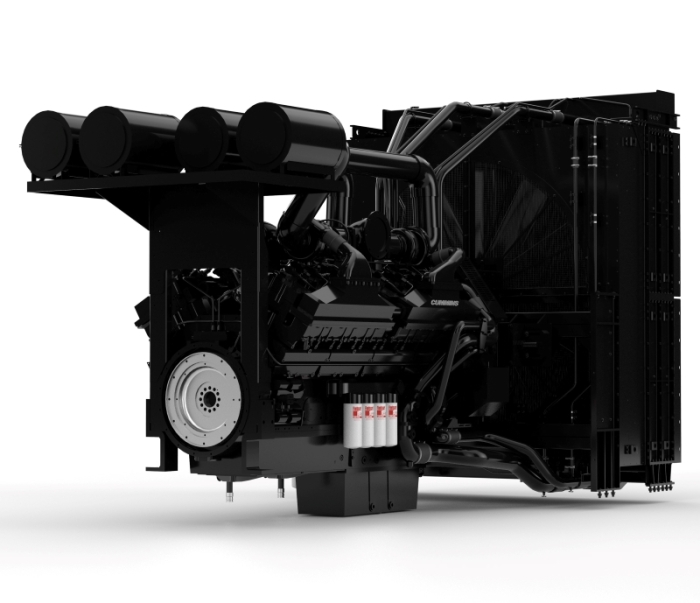
The CCEC QSK60 series is the largest and most powerful generator drive engine in the Chongqing Cummins G-Drive lineup — a 16-cylinder V-configuration, four-stroke, 60.2-liter diesel built by Chongqing Cummins Engine Co. (CCEC). It uses the Cummins MCRS modular common-rail fuel system at up to 1,600 bar injection pressure, HX82/HX83/HE851 turbocharging, and a two-pump two-loop (2P2L) low-temperature aftercooling system. Published genset ratings span 1,702–2,509 kVA across 50 Hz (1500 RPM) and 60 Hz (1800 RPM), with prime power from 1,362 kW up to 1,831 kW. When your project demands 2 MW+ of standby or prime power — hyperscale data centers, mining mega-sites, utility microgrids — the QSK60 is the top of the CCEC electronic range, sitting above the QSK50 and the V12 QSK38.
QSK60 Generator Engine Models
CCEC produces the QSK60 in G10, G11, and G12 ratings covering 50 Hz and 60 Hz. Ratings below are published genset outputs (kVA / kW) at 0.8 power factor, exactly as listed on the factory rating sheet. Each model carries a specific performance curve and configuration code for genset OEM integration.
50 Hz Models (1500 RPM)
| Engine Model | Prime Power | Standby Power | RPM |
|---|---|---|---|
| QSK60-G10 | 1,702 kVA / 1,362 kW | 1,875 kVA / 1,500 kW | 1500 |
| QSK60-G11 | 2,002 kVA / 1,602 kW | 2,254 kVA / 1,803 kW | 1500 |
| QSK60-G12 | 1,825 kVA / 1,460 kW | 2,002 kVA / 1,602 kW | 1500 |
60 Hz Models (1800 RPM)
| Engine Model | Prime Power | Standby Power | RPM |
|---|---|---|---|
| QSK60-G10 | 2,127 kVA / 1,702 kW | 2,345 kVA / 1,876 kW | 1800 |
| QSK60-G12 | 2,289 kVA / 1,831 kW | 2,509 kVA / 2,007 kW | 1800 |
Core Specifications
| Parameter | Value |
|---|---|
| Engine Type | 4-cycle, V-16 cylinder (60° Vee) |
| Displacement | 60.2 L (60 L class, ~3,670 in³) |
| Bore × Stroke | 159 mm × 190 mm (6.25 in × 7.48 in) |
| Rated Speed | 1,500 – 1,800 RPM |
| Frequency | 50 Hz / 60 Hz |
| Fuel System | MCRS — modular high-pressure common rail, fully electronic (up to 1,600 bar) |
| Aspiration | Turbocharged & low-temperature aftercooled — HX82 / HX83 / HE851 turbochargers, 2P2L two-pump two-loop cooling |
| Emissions | U.S. EPA Tier 2 / China Non-road Stage III |
| Prime Power Range | 1,362 – 1,847 kW @ 1,500 – 1,800 RPM |
| Genset Output Range | 1,702 – 2,509 kVA (at 0.8 PF, published ratings) |
| Dry Weight | 8,257 – 8,527 kg |
| Packing Size (L × W × H) | 2,960 × 1,780 × 2,150 mm |
| Starting System | 24V, negative ground |
| Manufacturer | CCEC (Chongqing Cummins Engine Co., Ltd.) |
Key Engineering Features
MCRS High-Pressure Common Rail
The Modular Common Rail Fuel System (MCRS) reaches up to 1,600 bar injection pressure, optimizing combustion for maximum power density and fuel efficiency. Fully electronic metering across the whole load range delivers fast transient response and tight governing — essential for UPS-paralleling and load-shedding duty in mission-critical installations.
Integrated Electronic Diagnostics
The engine ECM provides advanced integrated diagnostics, simplifying monitoring and maintenance. An electric priming pump controlled by the ECM improves reliability and ease of use, while stage-2 fuel filters mount directly on the engine for higher filtration efficiency and simpler service.
CTT Turbocharging
HX82, HX83, and HE851 turbochargers maximize exhaust energy recovery, reducing fuel consumption and emissions while sustaining rated output in high-ambient, high-altitude conditions. Turbo matching is calibrated to the MCRS fuel map to meet strict emissions standards without exhaust aftertreatment.
2P2L Low-Temperature Aftercooling
The two-pump, two-loop (2P2L) cooling system ensures efficient thermal management across the whole engine — vital for performance and longevity at 2 MW+ outputs. FCD (ferrous cast ductile iron) pistons provide the strength to withstand high cylinder pressures and the harshest continuous-duty conditions.
The QSK60 ships as a complete matched G-Drive assembly — engine, turbochargers, aftercooler, and electronic control module calibrated together for generator-set duty. It shares the 159 mm bore with the QSK50 and QSK38, with a longer 190 mm stroke for the extra 10 liters of displacement, and is backed by Cummins’ global after-sales service network.
Fuel Consumption (Typical)
Fuel is 70–80% of a generator set’s lifetime operating cost, and at 60 liters of displacement the numbers get serious fast — right-sizing a 2 MVA-class project can mean six-figure annual fuel savings. The figures below are typical estimates for a QSK60-class common-rail engine at rated speed; exact values vary by model rating, alternator efficiency, ambient conditions, and fuel quality. Request the factory fuel map for your specific model before finalizing a project.
| Load Point | Typical Power (kW) | Fuel Consumption (L/hr, approx.) |
|---|---|---|
| Standby (100%) | ~2,000 | ~510 |
| Prime (100%) | ~1,830 | ~470 |
| Prime (75%) | ~1,370 | ~355 |
| Prime (50%) | ~915 | ~245 |
Generators run most efficiently at 70–80% load. Running a QSK60 below 30% load for extended periods causes wet stacking and accelerates carbon buildup. If your continuous load is under ~1,700 kVA, the V16 QSK50 delivers similar emissions compliance with lower fuel burn; under ~1,300 kVA, step down to the V12 QSK38.
QSK60 vs QSK50 vs QSK38: Selection Guide
The QSK60 is the most powerful electronic G-Drive engine in the CCEC range. Here is how it compares to its V16 sibling the QSK50 and the V12 QSK38.
| Feature | QSK38 (Electronic V12) | QSK50 (Electronic V16) | QSK60 (Electronic V16) |
|---|---|---|---|
| Displacement | 37.7 L | 50.3 L | 60.2 L |
| Cylinders | 12 Vee | 16 Vee | 16 Vee |
| Bore × Stroke | 159 × 159 mm | 159 × 159 mm | 159 × 190 mm |
| Fuel System | MCRS common rail | MCRS common rail (1,600 bar) | MCRS common rail (1,600 bar) |
| Emissions | Tier 2 / Stage III | Tier 2 / Stage III | Tier 2 / Stage III |
| Prime Power Range | 876 – 1,231 kW | 1,021 – 1,462 kW | 1,362 – 1,831 kW |
| Genset kVA Range | 1,095 – 1,720 kVA | 1,277 – 2,017 kVA | 1,702 – 2,509 kVA |
| Dry Weight | 3,825 – 4,100 kg | 5,410 kg | 8,257 – 8,527 kg |
| Best For | 1.0–1.7 MVA, V12 value | 1.3–2.0 MVA, V16 balance | 1.7–2.5 MVA, maximum power |
Choose the QSK60 when your project needs 2 MVA+ of electronic, emissions-compliant power — it is the only CCEC engine that covers 2,200–2,500 kVA standby. Choose the QSK50 for 1.3–2.0 MVA with a lighter footprint and better fuel economy, and the QSK38 for 1.0–1.7 MVA on the V12 platform. For mechanical-engine alternatives in the same kVA classes, see our NTA855 vs KTA19 vs KTA38 vs KTA50 comparison guide.
Typical Applications
- Hyperscale data centers & colocation — 2.0–2.5 MVA standby sets with MCRS electronic governing, tight frequency regulation, and J1939 integration into UPS and paralleling switchgear.
- Mining mega-sites — primary power for whole mining camps, crusher-conveyor systems, dewatering pump fleets, and haul-truck workshops in high-dust, high-altitude environments.
- Oil & gas — onshore drilling rigs, large frac spreads, pipeline compressor stations, and gas processing plants requiring continuous-duty V16 reliability.
- Utility & island microgrids — base-load power for remote communities, islands, and industrial parks where the grid is absent or unreliable.
- Heavy industrial standby — steel mills, cement plants, smelters, and petrochemical complexes where 2 MVA+ backup is mission-critical.
- Marine auxiliary & offshore — large generator sets on FPSOs, offshore platforms, dredgers, and big cargo vessels.
- Large infrastructure & events — containerized 2.0–2.5 MVA units for airports, stadiums, mega construction projects, and disaster relief.
Genuine QSK60 Spare Parts
The QSK60 shares its MCRS electronic architecture with the QSK50, QSK38, and QSK19 — including the ECM electronic control module (2867198) — while its 60-liter V16 block, cranktrain, and FCD pistons are QSK60-specific heavy-duty components. We supply the full range of QSK60 spare parts: MCRS fuel injectors, high-pressure pumps and rails, HX82/HX83/HE851 turbochargers, filters, liners, bearings, gaskets, and overhaul kits. Browse the full Cummins engine parts center or send us your parts list for a quotation.
Maintenance & Service
| Service Item | Interval (typical) | Notes |
|---|---|---|
| Engine oil & filter | 250–500 hours | API CH-4/CI-4 or higher, 15W-40; use genuine Fleetguard filters |
| Fuel filters / water separator | 500 hours | Off-engine stage-1 (with electric priming pump) and on-engine stage-2; drain water regularly |
| Air filter | Inspect 500 h / replace as indicated | Dry element with restriction indicator |
| Coolant / SCA check | 500 hours | 2P2L two-pump two-loop system; maintain DCA concentration in both circuits |
| Valve lash adjustment | 2,000 hours / 2 years | Cold setting per CCEC/Cummins manual |
| ECM / MCRS diagnostic check | At each service | Read fault codes via Cummins INSITE software |
| Major overhaul | 20,000+ hours | Wet liners replaceable; depends on duty cycle |
Frequently Asked Questions
What is the most powerful CCEC generator engine?
The QSK60 is the most powerful generator drive engine in the CCEC lineup. Its top rating, the QSK60-G12 at 60 Hz, produces 2,289 kVA prime (1,831 kW) and 2,509 kVA standby (2,007 kW) — the highest published standby output of any Chongqing Cummins G-Drive engine. It is a 16-cylinder V-configuration, 60.2-liter MCRS electronic diesel.
What genset kVA does the QSK60 produce?
At 50 Hz (1500 RPM), published QSK60 ratings span 1,702–2,254 kVA (QSK60-G10 at 1,702 kVA prime to QSK60-G11 at 2,254 kVA standby). At 60 Hz (1800 RPM), they span 2,127–2,509 kVA, led by the QSK60-G12 at 2,509 kVA standby / 2,007 kW.
What is the difference between the QSK60 and QSK50?
Both are MCRS electronic V16 engines with a 159 mm bore, but the QSK60 uses a longer 190 mm stroke (vs 159 mm on the QSK50) for 60.2 liters of displacement versus 50.3 liters. The QSK60 covers 1,702–2,509 kVA and weighs 8,257–8,527 kg; the QSK50 covers 1,277–2,017 kVA at 5,410 kg. The two share MCRS electronics and the same turbocharger family, and many service parts and diagnostic tools are common.
How do I choose between the QSK60, QSK50, and QSK38?
Match the engine to your continuous load: QSK38 (V12, 37.7 L) for 1.0–1.7 MVA, QSK50 (V16, 50.3 L) for 1.3–2.0 MVA, and QSK60 (V16, 60.2 L) for 1.7–2.5 MVA. Running an engine at 70–80% load gives the best fuel economy and longest life — oversizing a QSK60 for a 1,200 kVA load wastes fuel and risks wet stacking, while undersizing a QSK38 for a 2 MVA project means no power margin.
Which applications is the QSK60 best suited for?
It is ideal for 2.0–2.5 MVA generator sets in hyperscale data centers, mining mega-sites, oil & gas facilities, utility microgrids, heavy industrial standby, and offshore/marine auxiliary power. The MCRS electronic system provides the tight frequency regulation and fast load acceptance that UPS paralleling and grid-support applications demand at the 2 MW level.
What is the lead time for a QSK60 generator engine?
Bare engines typically ship within 20–35 working days. Complete open, silent, or containerized generator sets require 30–50 days depending on alternator brand, controller, enclosure, and destination. We ship worldwide by sea (FOB/CIF/DAP) and can arrange air freight for urgent orders.
Official Resources
Genuine Cummins parts and service information: parts.cummins.com — or browse our full CCEC generator engine lineup.