
CCEC QSK50 Generator Drive Engine — V16 50L MCRS Common-Rail, 1,021–1,462 kW
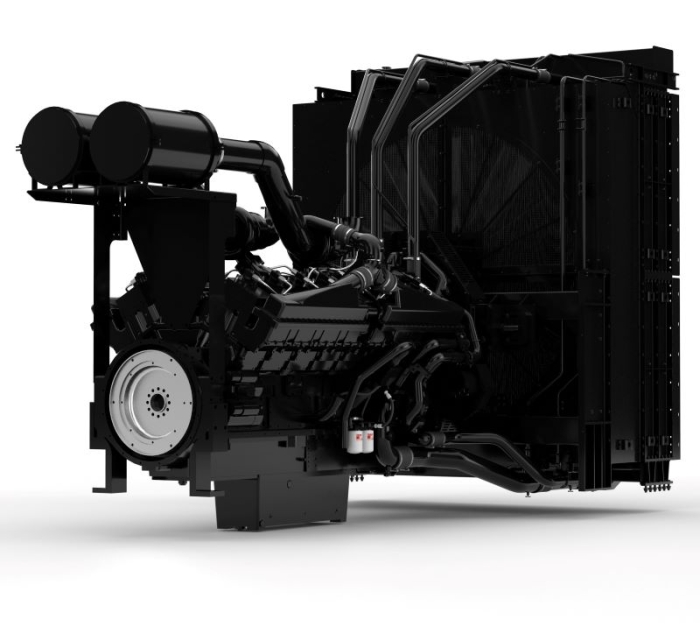
The CCEC QSK50 series is the electronically controlled flagship of the Chongqing Cummins G-Drive lineup — a 16-cylinder V-configuration, four-stroke, 50.3-liter diesel built by Chongqing Cummins Engine Co. (CCEC). It uses the Cummins MCRS modular common-rail fuel system at up to 1,600 bar injection pressure, paired with HX82/HX83/HE851 turbocharging and a two-pump, two-loop low-temperature aftercooling system. Published genset ratings span 1,277–2,017 kVA across 50 Hz (1500 RPM) and 60 Hz (1800 RPM), making the QSK50 the go-to V16 for 1.3–2.0 MVA standby and prime-power sets in data centers, mining, oil & gas, and utility-scale projects. It is the electronic successor to the mechanical KTA50 and the bigger brother of the V12 QSK38.
QSK50 Generator Engine Models
CCEC produces the QSK50 in G2 through G7 ratings covering 50 Hz and 60 Hz. Ratings below are published genset outputs (kVA / kW) at 0.8 power factor, exactly as listed on the factory rating sheet. Each model carries a specific performance curve and configuration code for genset OEM integration.
50 Hz Models (1500 RPM)
| Engine Model | Prime Power | Standby Power | RPM |
|---|---|---|---|
| QSK50-G2 | 1,277 kVA / 1,021 kW | 1,400 kVA / 1,120 kW | 1500 |
| QSK50-G3 | 1,600 kVA / 1,280 kW | 1,562 kVA / 1,249 kW | 1500 |
| QSK50-G7 | 1,651 kVA / 1,321 kW | 1,825 kVA / 1,460 kW | 1500 |
| QSK50-G7 (alt. rating) | 1,782 kVA / 1,421 kW | — | 1500 |
60 Hz Models (1800 RPM)
| Engine Model | Prime Power | Standby Power | RPM |
|---|---|---|---|
| QSK50-G2 | 1,382 kVA / 1,106 kW | 1,587 kVA / 1,270 kW | 1800 |
| QSK50-G3 | 1,600 kVA / 1,280 kW | 1,777 kVA / 1,422 kW | 1800 |
| QSK50-G4 | 1,708 kVA / 1,366 kW | 1,911 kVA / 1,529 kW | 1800 |
| QSK50-G5 | 1,708 kVA / 1,366 kW | 1,901 kVA / 1,528 kW | 1800 |
| QSK50-G6 | 1,828 kVA / 1,462 kW | 2,017 kVA / 1,614 kW | 1800 |
Core Specifications
| Parameter | Value |
|---|---|
| Engine Type | 4-cycle, V-16 cylinder (60° Vee) |
| Displacement | 50.3 L (50 L class, ~3,067 in³) |
| Bore × Stroke | 159 mm × 159 mm (6.25 in × 6.25 in) |
| Rated Speed | 1,500 – 1,800 RPM |
| Frequency | 50 Hz / 60 Hz |
| Fuel System | MCRS — modular high-pressure common rail, fully electronic (up to 1,600 bar) |
| Aspiration | Turbocharged & low-temperature aftercooled — HX82 / HX83 / HE851 turbochargers, two-pump two-loop cooling |
| Emissions | U.S. EPA Tier 2 / China Non-road Stage III |
| Advertised Power | Up to 1,582 kW @ 1,500 RPM |
| Genset Output Range | 1,277 – 2,017 kVA (at 0.8 PF, published ratings) |
| Dry Weight | 5,410 kg |
| Packing Size (L × W × H) | 2,794 × 1,507 × 1,846 mm |
| Starting System | 24V, negative ground |
| Manufacturer | CCEC (Chongqing Cummins Engine Co., Ltd.) |
Key Engineering Features
MCRS High-Pressure Common Rail
The Modular Common Rail Fuel System (MCRS) reaches up to 1,600 bar injection pressure, optimizing combustion for superior power density and fuel economy. Fully electronic metering across the whole load range gives fast transient response and tight governing — critical for data-center and UPS-paralleling duty.
Integrated Electronic Diagnostics
The engine ECM provides advanced on-engine diagnostics, simplifying monitoring and maintenance. An electric priming pump integrates with the off-engine stage-1 filter under ECM control for reliable startup, while on-engine stage-2 filters mount directly on the engine for efficient filtration and simplified service.
CTT Turbocharging
HX82, HX83, and HE851 turbochargers harvest exhaust energy efficiently, reducing fuel consumption and emissions while sustaining rated output in high-ambient, high-altitude conditions. Turbocharging is matched to the MCRS fuel map to meet strict emissions standards without aftertreatment.
Two-Loop Low-Temperature Aftercooling
The two-pump, two-loop cooling system maintains consistent engine temperature and delivers dense, cool intake charge for maximum volumetric efficiency. Ferrous cast ductile iron pistons withstand the high cylinder pressures of common-rail combustion, ensuring reliable performance under the toughest continuous-duty conditions.
The QSK50 ships as a complete matched G-Drive assembly — engine, turbochargers, aftercooler, and electronic control module calibrated together for generator-set duty. It shares the proven 159 mm × 159 mm bore-and-stroke architecture with the QSK38, KTA50, and QSK60, giving broad parts commonality across the 38/50/60-liter heavy-duty family — and it is backed by Cummins’ global after-sales service network.
Fuel Consumption (Typical)
Fuel is 70–80% of a generator set’s lifetime operating cost, so right-sizing matters on a 50-liter V16. The figures below are typical estimates for a QSK50-class common-rail engine at rated speed; exact values vary by model rating, alternator efficiency, ambient conditions, and fuel quality. Request the factory fuel map for your specific model before finalizing a project.
| Load Point | Typical Power (kW) | Fuel Consumption (L/hr, approx.) |
|---|---|---|
| Standby (100%) | ~1,600 | ~415 |
| Prime (100%) | ~1,450 | ~370 |
| Prime (75%) | ~1,090 | ~285 |
| Prime (50%) | ~725 | ~195 |
Generators run most efficiently at 70–80% load. Running a QSK50 below 30% load for extended periods causes wet stacking and accelerates carbon buildup. If your continuous load is under ~1,000 kVA, the V12 QSK38 burns less fuel; if you prefer mechanical simplicity on the same 50-liter block, the KTA50 covers the same kVA class with a PT fuel system.
QSK50 vs QSK38 vs KTA50: Selection Guide
The QSK50 is the most powerful electronic G-Drive engine in the CCEC range. Here is how it compares to its V12 sibling the QSK38 and its mechanical predecessor the KTA50.
| Feature | QSK38 (Electronic V12) | QSK50 (Electronic V16) | KTA50 (Mechanical V16) |
|---|---|---|---|
| Displacement | 37.7 L | 50.3 L | 50.3 L |
| Cylinders | 12 Vee | 16 Vee | 16 Vee |
| Fuel System | MCRS common rail | MCRS common rail (1,600 bar) | PT + STC mechanical |
| Emissions | Tier 2 / Stage III | Tier 2 / Stage III | Stage II (pre-Tier) |
| 50 Hz Prime Range | 876 – 1,107 kW | 1,021 – 1,421 kW | 1,097 – 1,650 kW |
| Genset kVA Range | 1,095 – 1,720 kVA | 1,277 – 2,017 kVA | ~1,300 – 2,000+ kVA |
| Dry Weight | 3,825 – 4,100 kg | 5,410 kg | ~5,300 kg class |
| Best For | 1,000–1,700 kVA, electronic V12 | 1,300–2,000 kVA, top electronic V16 | 1,300–2,000 kVA, mechanical preference |
Choose the QSK50 when your project needs 1.3–2.0 MVA with electronic fuel control, EPA Tier 2 compliance, and the fastest load acceptance in the CCEC range. Choose the QSK38 for 1.0–1.7 MVA on a lighter, more fuel-efficient V12; choose the KTA50 when mechanical PT simplicity and tolerance of variable fuel quality matter more than electronic governing. For the full mechanical lineup, see our NTA855 vs KTA19 vs KTA38 vs KTA50 comparison guide.
Typical Applications
- Data centers & hyperscale colocation — 1.3–2.0 MVA standby sets with MCRS electronic governing, tight frequency regulation, and J1939 integration into UPS and paralleling switchgear.
- Mining & quarrying — primary and standby power for haul truck shops, crushers, conveyors, dewatering pumps, and mining camps in high-dust, high-altitude environments.
- Oil & gas — onshore drilling rigs, frac spreads, pump stations, and pipeline compressor stations requiring continuous-duty V16 reliability.
- Utility & microgrid prime power — island grids, remote communities, and industrial parks where the grid is absent or unreliable.
- Heavy industrial standby — steel mills, cement plants, smelters, and petrochemical plants where 1.5+ MVA backup is mission-critical.
- Marine auxiliary & offshore — generator sets on large cargo vessels, dredgers, offshore platforms, and FPSO support.
- Construction & rental fleets — containerized 1.5–2.0 MVA units for mega infrastructure projects, events, and disaster relief.
Genuine QSK50 Spare Parts
The QSK50 shares the proven 50-liter V16 architecture with the KTA50 and QSK60 — and its MCRS electronics with the QSK38 and QSK19 — giving it one of the broadest parts pools in the CCEC range. We supply the full range of QSK50 spare parts, including the MCRS fuel injector (4955526), flywheel (3021394), ECM electronic control module (2867198), plus HX82/HX83/HE851 turbochargers, MCRS high-pressure pumps and rails, filters, liners, bearings, and overhaul gasket kits. Browse the full Cummins engine parts center or send us your parts list for a quotation.
Maintenance & Service
| Service Item | Interval (typical) | Notes |
|---|---|---|
| Engine oil & filter | 250–500 hours | API CH-4/CI-4 or higher, 15W-40; use genuine Fleetguard filters |
| Fuel filters / water separator | 500 hours | Off-engine stage-1 (with electric priming pump) and on-engine stage-2; drain water regularly |
| Air filter | Inspect 500 h / replace as indicated | Dry element with restriction indicator |
| Coolant / SCA check | 500 hours | Two-pump two-loop system; maintain DCA concentration in both circuits |
| Valve lash adjustment | 2,000 hours / 2 years | Cold setting per CCEC/Cummins manual |
| ECM / MCRS diagnostic check | At each service | Read fault codes via Cummins INSITE software |
| Major overhaul | 20,000+ hours | Wet liners replaceable; depends on duty cycle |
Frequently Asked Questions
What is the difference between the QSK50 and KTA50?
Both are 50.3-liter V16 engines sharing the same 159 mm bore and stroke, but the QSK50 uses the MCRS high-pressure common-rail system (up to 1,600 bar) with fully electronic control, while the KTA50 uses a mechanical PT pump with STC timing. The QSK50 meets EPA Tier 2 / China Stage III emissions without aftertreatment, delivers faster transient response and tighter speed regulation for UPS paralleling. The KTA50 remains popular in markets where mechanical simplicity and tolerance of variable fuel quality are preferred.
What genset kVA does the QSK50 produce?
At 50 Hz (1500 RPM), published QSK50 ratings span 1,277–1,782 kVA prime (QSK50-G2 at 1,277 kVA to QSK50-G7 at 1,782 kVA). At 60 Hz (1800 RPM), they span 1,382–2,017 kVA standby, led by the QSK50-G6 at 2,017 kVA standby (1,614 kW) — the highest standby rating in the CCEC G-Drive lineup.
How do I choose between the QSK50 and QSK38?
The QSK38 is a V12, 37.7-liter engine covering 1,095–1,720 kVA; the QSK50 is a V16, 50.3-liter engine covering 1,277–2,017 kVA. For continuous loads around 1,000 kVA the QSK38 is more fuel-efficient; for projects needing 1.5 MVA+ standby power or the fastest load acceptance, choose the QSK50. Both use the MCRS electronic common-rail system, meet EPA Tier 2, and share many parts.
Is the QSK50 compatible with the KTA50 for parts?
Yes — extensively. The QSK50 shares the same V16 block architecture, bore/stroke, and many rotating and reciprocating components with the KTA50 and QSK60. Cylinder blocks, pistons, flywheels, and many internal parts cross-reference across platforms. However, fuel system components (MCRS injectors, rail, high-pressure pump, ECM) are QSK-specific and not interchangeable with mechanical KTA50 PT parts.
Which applications is the QSK50 best suited for?
It is ideal for 1.3–2.0 MVA generator sets in hyperscale data centers, mining, oil & gas, utility microgrids, heavy industrial standby, and offshore/marine auxiliary power. The MCRS electronic system provides the tight frequency regulation and fast load acceptance that UPS and paralleling applications demand, while the V16 architecture delivers power density no inline or V12 engine can reach in this kVA class.
What is the lead time for a QSK50 generator engine?
Bare engines typically ship within 15–30 working days. Complete open, silent, or containerized generator sets require 25–45 days depending on alternator brand, controller, enclosure, and destination. We ship worldwide by sea (FOB/CIF/DAP) and can arrange air freight for urgent orders.
Official Resources
Genuine Cummins parts and service information: parts.cummins.com — or browse our full CCEC generator engine lineup.